


With the purpose stated above, an International Elephant Race was organized in the Tourist Village of Sauraha in December 26 and 27 of 2005. This race was organized for Charity purpose. Twenty-nine elephants had taken part under the banners of national and international teams and some 15,000 domestic and international tourists have participated and were delighted. This event was given coverage by BBC, Chinese and Indian TV channels and was given proper publicity by the entire national newspapers and T.V. channels of Nepal. This was only a small and humble beginning, but it has greatly encourages us to organize this event with better management and larger participation. We can safely target to get 30,000 tourists participation in this event in December 2006, which may last for 4-5 days.  As the great Asian Elephant, the most intelligent, friendly, beneficial and biggest mammal on earth is practically at the verge of extinction, we the people of Saurha at the main gateway of Chitwan National Park, want to draw the kind attention of the conscious animal lovers and ecologically conscious intellectuals of the world, about this unhappy situation. As some 10,000 people of this area are directly dependent on tourism industry and as the elephants are the backbone of this industry, it is also necessary for us to save elephants.
|
 |
Wednesday, September 1, 2010
Elephant race In Nepal!!!

Elephant Polo !!! Nepal is the place where world cup takes place !!!
Elephant polo is a variant of polo played whilst riding elephants. It is played in Nepal, Sri Lanka, Rajasthan (India), and Thailand. Equipment consists of a standard polo ball and six to nine foot cane (similar to bamboo) sticks with a polo mallet head on the end. The pitch is three-quarters of the length of a standard polo pitch, due to the slower speed of the elephants. Two people ride each elephant; the elephants are steered by mahouts, while the player tells the mahout which way to go and hits the ball.
Although elephant polo was first played in India at the beginning of the twentieth century, the modern game originated in Meghauli, Nepal, reportedly after a drinking bout.[citation needed] Tiger Tops in Nepal remains the headquarters of elephant polo and the site of the World Elephant Polo Championships. As of December 2008, the world elephant polo champions were in England.[1]
Elephant Polo in Nepal and Thailand is played under the auspices of the World Elephant Polo Association. WEPA enforces strict rules regarding elephant welfare and game play. As of March 2010, Audemars Pigeut, France is the reigning champion of the World Elephant Polo Association.[2] Other tournaments, such as those played in India and Sri Lanka, are managed independently of each other and the World Elephant Polo Association. Sri Lanka held an annual tournament in Galle under the auspices of the Ceylon Elephant Polo Association. No matches have been played since February 2007, however, when an elephant went on a rampage during a game, injuring two players and destroying the Spanish team's minibus

Most of the rules of the games are based on horse polo, but the pitch is 3/4 length (because of the slower speed of the elephants) and there are some necessary additions - for instance, it is a penalty for an elephant to lie down in front of the goal line. Players are secured in rope harnesses, with a rope across their thighs and rope stirrups. The game will stop if a player's harness becomes too loose and there is a danger of the player falling off. Players have fallen off elephants only a few times in WEPA's 20-year history.
The primary difference between horse and elephant polo, besides the substitution of an elephant for a horse, is that the elephants are "driven" by their trainers, called "mahouts." The mahouts have generally worked with the elephant for many years and the elephants respond quickly to the mahout’s signals and commands. The mahout communicates with the elephant with verbal commands and by applying pressure to the back of the elephant's ears with their feet. The player's responsibility is to let the mahout know where to go, how fast, when to stop, etc. Most of the mahouts and all of the elephants only understand Nepali, so the communication is difficult at times. The professional players tend to learn some basics Nepali to help with the communication on the pitch.
The primary difference between horse and elephant polo, besides the substitution of an elephant for a horse, is that the elephants are "driven" by their trainers, called "mahouts." The mahouts have generally worked with the elephant for many years and the elephants respond quickly to the mahout’s signals and commands. The mahout communicates with the elephant with verbal commands and by applying pressure to the back of the elephant's ears with their feet. The player's responsibility is to let the mahout know where to go, how fast, when to stop, etc. Most of the mahouts and all of the elephants only understand Nepali, so the communication is difficult at times. The professional players tend to learn some basics Nepali to help with the communication on the pitch.

Jungle safari In Nepal
| Jungle Safari In Nepal | |||||||||||
 | |||||||||||
Nepal is a country of exceptional biodiversity and a beautiful natural environment. The tropical jungles of the Terai preserve some of the best wildlife habitat in the subcontinent. Nepal has 16 national parks, wildlife reserves and conservation areas, occupying 16 percent of its total geographical area. For those who wish to experience the natural environment at its best there is no better place to visit than Nepal. The outdoor adventure sports into the wilderness to see wild animals, birds and natural beauty. You ride on an elephant's back or on a four wheeler jeep accompanied by a fully trained guide (also known as expert Naturalists) for the love of nature and animals. In Nepal, Chitwan and Bardia are two hot dishes on the menu. Pick Chitwan as this is Nepal's most popular National Park offering excellent opportunity to see Royal Bengal Tigers, One horned Rhino, crocodile and thrilling wilderness experience into its deep and thick jungle. Pick Bardia also, as this is another National Park, which offers excellent jungle safari. Here too you can ride on an elephant or a take four wheel to discover some of Nepal's unspoiled natural habitats. Most jungle safari consists of canoe rides on the jungle rivers, nature walks, birds watching excursions and quick tours around the villages to discover unique culture and traditions of the local village people. There are also scheduled cultural-musical programs performed by the villages, which are also in the Jungle Safari itinerary. Chitwan and Bardia national park have excellent accommodation. 
 |
| Royal Bardia National Park | ||||
| ||||
Established in 1984, this park is situated in Nepal’s western Terai. It covers 968 sq. km. The park offers a variety of experiences in its vast undisturbed wilderness. About 70% of the forest consists of sal trees (which are used for the beautifully carved windows in Kathmandu) with a mixture of grass land and riverine forest. The park is home to endangered animals such as the Bengal tiger, wild elephant, greate. One-horned rhinoceros, swamp deer, and black buck. Other endangered species include gharial crocodile, marsh mugger and Gangetic dolphin, 200 species of birds and several species of snakes can also be seen in the park. Certain ethnic groups live in the park as well and you can experience their culture and traditions | ||||
| How much will it cost? Cost mainly depends on your duration of stay and your choice of accommodation. Most jungle safari packages are for 2 nights to 3 days costing on average US$ 70 to 400 which includes transportation, food, and accommodation, all the activities in the park and park fee.Note: We do our best to make your visit as best as possible, so please contact us for more information.What to bring with you? 1. Binoculars 2. Sun Hat and Sun Cream 3. Swim Wear 4. Light Clothes; Color should blend with natural surroundings 5. Light sweater or jacket for mornings and evenings during the winter season (Dec to Feb) 6. Shoes for easy movement 7. Flashlight 8. Swiss knife 9. Reading books | ||||
|

White water rafting in nepal
Nepal is home to eight out of the fourteen highest peaks in the world with colorful and intricate Hindu religion to the austerity of the Buddhist monasteries. From these breathtaking heights, rivers crash down through the foothills, fed by monsoon rains and melting snow, on their way to the Great Plains of the Ganges.
Nepal has many rivers for you to explore: Trishuli River (rafting for 1 up to 3 days), Seti River (rafting trip 2 days), Bhote Koshi River (rafting 2 days), Kali Gandaki River (rafting 3 days), Marsyandi River (rafting/kayaking 4 days), Sun Koshi River (rafting 7 to 9 days), Arun River (rafting adventure 9 days), Karnali River (whitewater rafting 10 days), Tamur River (rafting adventure 11 days). On these rivers you will find the world's most thrilling whitewater with a wide range of difficulties, warm water and bug free beaches for camping. All this makes a wealth of unlimited opportunities for great river rafting, kayaking, climbing, mountaineering, biking, hiking and ever popular trekking adventures in Nepal. Nepal has something to offer to everyone.
We are proud to share our wonderful country, culture and our many years of experience in this field with you and give you an excellent opportunity to explore the remote countryside which is never possible without river trips.
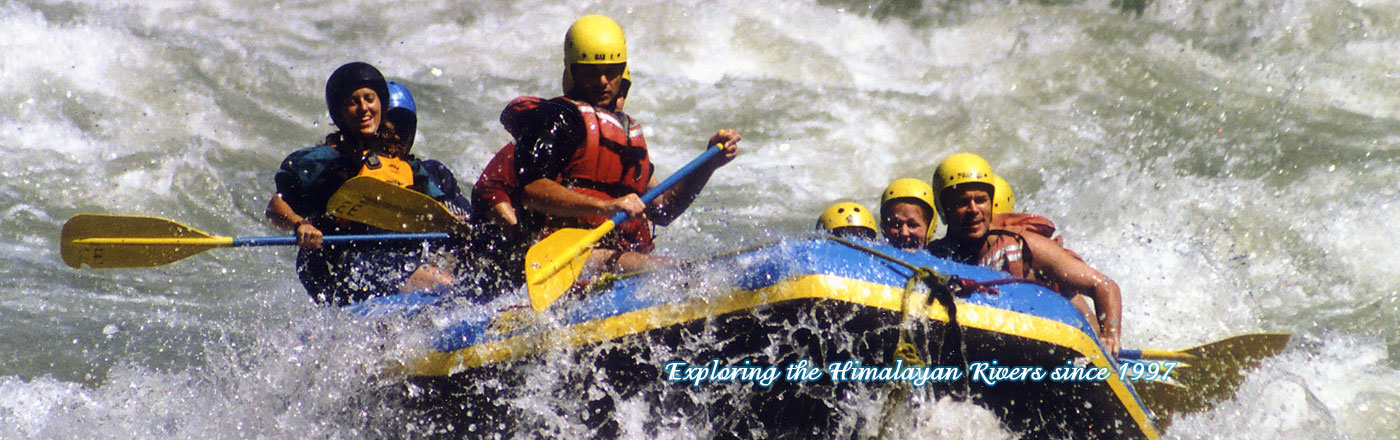 Karnali River is one of the finest big volume rafting and kayaking trips in Nepal-spectacular, remote, jungle-clad canyons, Big white and abundant wildlife. The Karnali is Nepal's longest and largest river and with its tributaries it drains most of the far west of Nepal-the 'wild west' as many people call it, rising in the vicinity of Tibet's holy Mount Kailash and glacier of Kanziroba Himal, other small peaks, as well as Rara lake rapid encountered on this river is 1 to 5 class. This bottom section of the river definitely lives up to that name-the area that it flows through is wild and relatively unpopulated with some of the most pristine jungle scenery in Nepal abundant wildlife.
From the frontier town of Surkhet there is an unique and lovely two-day trek through lowland Sal forest to the village of Saul in the seldom seen area of far West Nepal. From Sauli it's 180 km to the nest road access at Chisopani, on the northern border of the Royal Bardia National Park. The river section takes about seven days, giving plenty of time to explore some of the side canyons and waterfalls, which comes in to the river valley. For 180 kilometers we won't see a single sign of the modern world. It's one of the last places in Nepal that you can see old growth forest and have a real chance of seeing Nepal's wildlife. The rapids are also pretty wild, with the river building to its climax in these lower canyons shortly after the sharp bend in the river 'the elbow' by the Lohore Khola, the valley narrows into a series of canyons, the river speeds up, and there are big rapids, one leading into another, almost continuously down to the Seti river from the 'Elbow' down to the Seti the gradient is 3m/km (15ft a mile), but after here, the gradient eases, as the river winds through some magnificent un-spoilt scenery, eventually emerging onto the plains and flowing through the Royal Bardia National Park to join the Ganges. Finally leaving you close to Bardia National Park, where you can combine your rafting adventure with a safari trip and maybe spot some of the parks one-horned rhinos and elusive tigers or you can either drive back or fly back to Kathmandu.
Go on this trip if you want a true expedition style adventure and a totally classic river journey.

Nepal has many rivers for you to explore: Trishuli River (rafting for 1 up to 3 days), Seti River (rafting trip 2 days), Bhote Koshi River (rafting 2 days), Kali Gandaki River (rafting 3 days), Marsyandi River (rafting/kayaking 4 days), Sun Koshi River (rafting 7 to 9 days), Arun River (rafting adventure 9 days), Karnali River (whitewater rafting 10 days), Tamur River (rafting adventure 11 days). On these rivers you will find the world's most thrilling whitewater with a wide range of difficulties, warm water and bug free beaches for camping. All this makes a wealth of unlimited opportunities for great river rafting, kayaking, climbing, mountaineering, biking, hiking and ever popular trekking adventures in Nepal. Nepal has something to offer to everyone.
We are proud to share our wonderful country, culture and our many years of experience in this field with you and give you an excellent opportunity to explore the remote countryside which is never possible without river trips.
Karnali River is one of the finest big volume rafting and kayaking trips in Nepal-spectacular, remote, jungle-clad canyons, Big white and abundant wildlife. The Karnali is Nepal's longest and largest river and with its tributaries it drains most of the far west of Nepal-the 'wild west' as many people call it, rising in the vicinity of Tibet's holy Mount Kailash and glacier of Kanziroba Himal, other small peaks, as well as Rara lake rapid encountered on this river is 1 to 5 class. This bottom section of the river definitely lives up to that name-the area that it flows through is wild and relatively unpopulated with some of the most pristine jungle scenery in Nepal abundant wildlife. From the frontier town of Surkhet there is an unique and lovely two-day trek through lowland Sal forest to the village of Saul in the seldom seen area of far West Nepal. From Sauli it's 180 km to the nest road access at Chisopani, on the northern border of the Royal Bardia National Park. The river section takes about seven days, giving plenty of time to explore some of the side canyons and waterfalls, which comes in to the river valley. For 180 kilometers we won't see a single sign of the modern world. It's one of the last places in Nepal that you can see old growth forest and have a real chance of seeing Nepal's wildlife. The rapids are also pretty wild, with the river building to its climax in these lower canyons shortly after the sharp bend in the river 'the elbow' by the Lohore Khola, the valley narrows into a series of canyons, the river speeds up, and there are big rapids, one leading into another, almost continuously down to the Seti river from the 'Elbow' down to the Seti the gradient is 3m/km (15ft a mile), but after here, the gradient eases, as the river winds through some magnificent un-spoilt scenery, eventually emerging onto the plains and flowing through the Royal Bardia National Park to join the Ganges. Finally leaving you close to Bardia National Park, where you can combine your rafting adventure with a safari trip and maybe spot some of the parks one-horned rhinos and elusive tigers or you can either drive back or fly back to Kathmandu.
Go on this trip if you want a true expedition style adventure and a totally classic river journey.

Trip itinerary
A unique river passing through the two greenery hills usually explored by beginner and intermediate kayak learners and rafters. It has impressive gorges exciting rapids on its small volume white water.
Day 1 : We travel to the far west and arrive in Surkhet very late/early hours of the next morning, You are able to have a sleep here.
Day 2 : After breakfast, we will take a truck as far as the road goes until about lunch time [this all depends on availability be flexible]. After lunch we walk all afternoon to the put-in point at Sauli. A great walk which high lights just how "out there" you really are. You pass local villages and spectacular scenery, and then you hit the river.
Day 3 : After having heavy breakfast at 8:00 a.m. we get ready for wild ride. This section of the River is terribly wild. Continues rapid makes rafter forget to breathe. Lunch will be served en-route and camping at 03:00 p.m. in First Inquiry.
Day 4 : This is the type of day that people imagine when they think of Himalayan water. It is big and continuous. We enter into the Jungle Corridor. This is a narrowing jungle clad gorge and it is all ours. The team building is put into full practice and when your guide shouts "all forward " he really means it. Enjoy the ride all day and camp in this sensational setting at God-house.
Day 5 : More of the same including the notorious GOD'S house rapid. Camp at the Seti Dovan and relax.
Day 6 : It isn't over yet! Keep paddling hard! You really are experiencing the best of the west on yet another day of great action and breath taking scenery and camping at Jamuna village
Day 7 : This is a holiday after all so we have programmed a rest day so you can take time to enjoy your surroundings and relax on a great sandy beach.
Day 8 - 9 : We see the rapids dying off as we come out of the gorge. We pass the confluence with the Seti River where the river broadens. Today, the next day and a half are a chance to enjoy your journey admiring the country and villages you pass. You will have seen the safety kayakers in action and will no doubt be inspired, so ask the guides for some supervised instruction, or take over the raft and learn about the river. You see there is more to a rafting expedition than just rafting.
Day 10 : This is the final day of river. We end this trip in the early afternoon at Chisopani Bridge & lunch is served there. You will catch night bus at about 1530hrs to get back to Kathmandu or you can enjoy in Bardia National Park, which is famous for bird watching.

A unique river passing through the two greenery hills usually explored by beginner and intermediate kayak learners and rafters. It has impressive gorges exciting rapids on its small volume white water.
Day 1 : We travel to the far west and arrive in Surkhet very late/early hours of the next morning, You are able to have a sleep here.
Day 2 : After breakfast, we will take a truck as far as the road goes until about lunch time [this all depends on availability be flexible]. After lunch we walk all afternoon to the put-in point at Sauli. A great walk which high lights just how "out there" you really are. You pass local villages and spectacular scenery, and then you hit the river.
Day 3 : After having heavy breakfast at 8:00 a.m. we get ready for wild ride. This section of the River is terribly wild. Continues rapid makes rafter forget to breathe. Lunch will be served en-route and camping at 03:00 p.m. in First Inquiry.
Day 4 : This is the type of day that people imagine when they think of Himalayan water. It is big and continuous. We enter into the Jungle Corridor. This is a narrowing jungle clad gorge and it is all ours. The team building is put into full practice and when your guide shouts "all forward " he really means it. Enjoy the ride all day and camp in this sensational setting at God-house.
Day 5 : More of the same including the notorious GOD'S house rapid. Camp at the Seti Dovan and relax.
Day 6 : It isn't over yet! Keep paddling hard! You really are experiencing the best of the west on yet another day of great action and breath taking scenery and camping at Jamuna village
Day 7 : This is a holiday after all so we have programmed a rest day so you can take time to enjoy your surroundings and relax on a great sandy beach.
Day 8 - 9 : We see the rapids dying off as we come out of the gorge. We pass the confluence with the Seti River where the river broadens. Today, the next day and a half are a chance to enjoy your journey admiring the country and villages you pass. You will have seen the safety kayakers in action and will no doubt be inspired, so ask the guides for some supervised instruction, or take over the raft and learn about the river. You see there is more to a rafting expedition than just rafting.
Day 10 : This is the final day of river. We end this trip in the early afternoon at Chisopani Bridge & lunch is served there. You will catch night bus at about 1530hrs to get back to Kathmandu or you can enjoy in Bardia National Park, which is famous for bird watching.

Bungy Jumping In Nepal
The word "bungee" (pronounced /ˈbʌndʒiː/) originates from West Country dialect, meaning "Anything thick and squat", as defined by James Jennings in his book "Observations of Some of the Dialects in The West of England" published 1825. Around 1930 the name became used for a rubber eraser. The word bungy, as used by A J Hackett, is "Kiwi slang for an Elastic Strap".[4] Cloth-covered rubber cords with hooks on the ends have been available for decades under the generic name bungy cords.
In the 1950s David Attenborough and a BBC film crew brought back footage of the "land divers" (known as "Naghol") of Pentecost Island inVanuatu, young men who jumped from tall wooden platforms with vines tied to their ankles as a test of their courage and passage into manhood.[5] A similar practice, only with a much slower pace for falling, has been practised as the Danza de los Voladores de Papantla or the 'Papantla flyers' of central Mexico, a tradition dating back to the days of the Aztecs.
A tower 4,000 feet high with a system to drop a “car” suspended by a cable of “best rubber” was proposed for the Chicago World Fair, 1892-1893. The car, seating two hundred people, would be shoved from a platform on the tower and then bounce to a stop. The designer engineer suggested that for safety the ground below “be covered with eight feet of feather bedding”. The proposal was declined by the Fair’s organizers.[6]

The first modern bungee jumps were made on 1 April 1979 from the 250-foot Clifton Suspension Bridge in Bristol, by David Kirke, Chris Baker, Simon Keeling, Tim Hunt and Alan Weston of the Oxford University Dangerous Sports Club.[7] The jumpers were arrested shortly after, but continued with jumps in the US from the Golden Gate and Royal Gorge bridges, (this last jump sponsored by and televised on the Americanprogram That's Incredible) spreading the concept worldwide. By 1982 they were jumping from mobile cranes and hot air balloons.
Commercial bungee jumping began with the New Zealander, A J Hackett, who made his first jump from Auckland's Greenhithe Bridge in 1986.[8] During the following years Hackett performed a number of jumps from bridges and other structures (including the Eiffel Tower), building public interest in the sport, and opening the world's first permanent commercial bungee site; the Kawarau Bridge Bungy at Queenstown in theSouth Island of New Zealand.[9] Hackett remains one of the largest commercial operators, with concerns in several countries.
Despite the inherent danger of jumping from a great height, several million successful jumps have taken place since 1980. This is attributable to bungee operators rigorously conforming to standards and guidelines governing jumps, such as double checking calculations and fittings for every jump. As with any sport, injuries can still occur (see below), and there have been fatalities. A relatively common mistake in fatality cases is to use a cord that is too long. The cord should be substantially shorter than the height of the jumping platform to allow it room to stretch. When the cord reaches its natural length the jumper either starts to slow down or keeps accelerating depending upon the speed of descent. One may not even start to slow until the cord has been stretched a significant amount, because the cord's resistance to distortion is zero at the natural length, and increases only gradually after, taking some time to even equal the jumper's weight. See also Potential energyfor a discussion of the spring constant and the force required to distort bungee cords and other spring-like objects.
Bungy jumping, if you thought bungy jumping was restricted to some places in europe, newszland and america , its time you have to move to a natural home in the highest mountain range in the world . The ultimate thrill of bungee jumping can be experiences in nepal and perhaps the best site in the worl.
nepal first bungee jumping site is situated 160 m over the bhote koshi river and located close to nepal -tibet border, a three hours bus ride from the capital of nepal kathmandu.
the Jump was designed by one of newzland 's leading bungy consulatants, and is operated by some of the most experiences jump masters in the buisness. its mishap proof.

Anyone who wants to take a taste of bungee jumping should not have any of the health problems mentioned below:
- Heart disease
- Epilepsy,
- High blood pressure,
- Pregnancy,
- Addiction to alcohol or drugs,
- Orthopedic problems,
- Psychological problems,
- Neurological problems.
Subscribe to:
Posts (Atom)


